
Forgotten feet
We often forget about our feet, until they hurt. We decorate them, file the heels, paint the nails, tuck them into shoes, but rarely do we treat them as what they truly are: the very foundation of our body’s structure and one of the most powerful access points to our overall wellbeing.
Your feet carry you through life. Every step you take, every shift in posture, every moment of balance depends on them. And yet, they are so often neglected – even in professional treatments. You might receive a full-body massage, but how often do your feet get the focused attention they deserve?
Too often, they are an afterthought, assumed to “just keep working.”
But anatomically and energetically, the feet are far from simple. They are dense with structure and sensation. Each foot holds over 7,000 nerve endings – making them fairly sensitive – but they also contain 26 bones, 33 joints, and a complex system of ligaments, muscles, and most importantly: fascia.
Fascinating fascia
Fascia is the body’s connective web. In the foot, the plantar fascia spans from the heel to the toes like a taut bowstring. It plays a vital role in our walking mechanism, known as the windlass effect – tightening as the toes extend, supporting the arch, and storing elastic energy like a spring. But this local system doesn’t act alone.
Fascia connects the sole of the foot to the calves, hamstrings, spine, and even the base of the skull. A restriction in the foot – tightness, collapse of the arch, tension in the toes – can influence your entire posterior chain, affecting posture, pelvic alignment, and spinal mechanics.
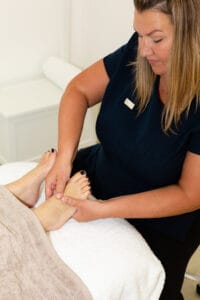
This is why regular foot massage and reflexology are not simply relaxing. They are a form of deep structural self-care. Through pressure, stretching, and stimulation of specific zones on the foot, we release not only local tension but also create ripple effects across the fascial lines and the nervous system.
Reflexology takes this further, mapping internal organs and systems onto the soles of the feet, offering a way to regulate stress, digestion, hormone balance, and sleep – all through the language of touch.
Walking in your shoes?
And then there’s the modern tragedy of shoes. Pointy, narrow, or overly cushioned footwear may look elegant, but they compress the toes, alter the gait, and disrupt the natural biomechanics of the foot. Over time, this creates structural compensation up the kinetic chain – from knees to hips, spine, and even shoulders. We see this reflected in lower back pain, tension headaches, and chronic fatigue that often begin, subtly, in the forgotten terrain of the feet.
Self-massage of the feet can be a potent daily ritual. Rolling a spiky ball or wooden roller under the sole, applying oil with loving pressure, or simply stretching the toes and arches – all these help reawaken proprioception (your body’s internal sense of position and movement) and send calming signals to the nervous system. This not only restores your connection to the Earth but also recalibrates your posture from the ground up. Regular feet massages, walking bare foot and receiving reflexology are the best way to healthy feet, as well as relaxed body and mind.
The truth is: the body remembers. And the feet, in their silent resilience, hold the stories of movement, fatigue, grounding, and survival. Giving them attention is a way to return home to yourself, structurally, emotionally, and energetically.